

Face Oil vs Moisturiser: What's the Difference?
Updated: Aug 8
Face oils and moisturisers are often treated as interchangeable skincare products, but they don't necessarily perform the same job.
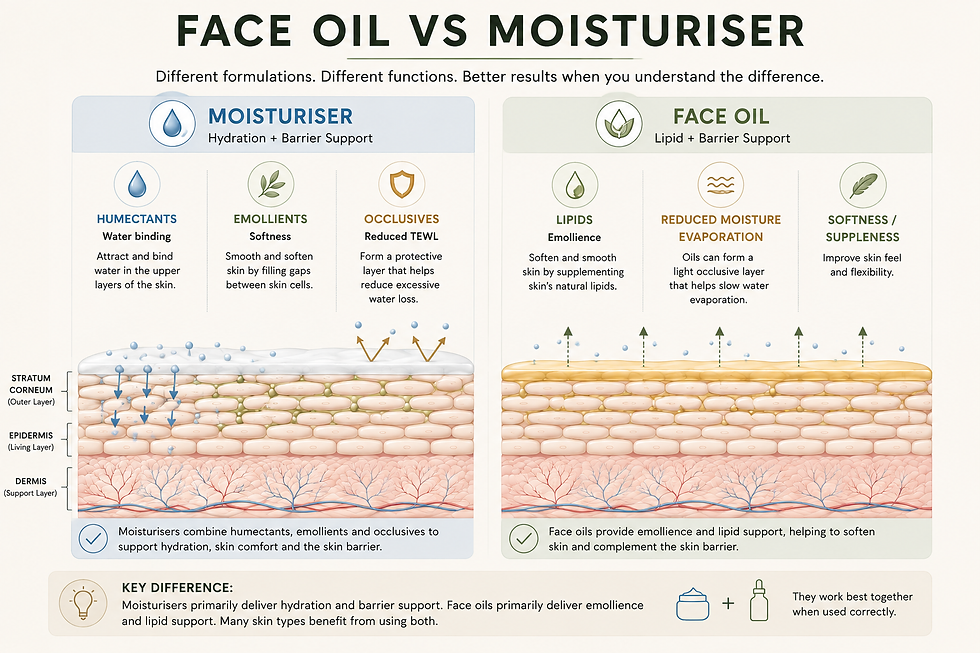
A conventional moisturiser is typically an emulsion containing both water and oil-based ingredients, allowing it to combine humectants, emollients and occlusives within a single formulation. A face oil, by contrast, is usually an anhydrous blend of oils and other oil-soluble ingredients, meaning its primary role is generally emollience and lipid support rather than directly supplying water to the skin.
That distinction matters. Depending on your skin and the formulation you're using, a face oil may complement a moisturiser, provide sufficient emollience on its own, or simply add more richness than your skin needs.
In this guide, we'll look at the science behind face oil vs moisturiser, what each actually does and when you might benefit from using one - or both.
If you're new to skin barrier science, start with our Skin Barrier: The Complete Guide.

What Does a Moisturiser Do?
Moisturisers are designed to improve skin hydration and comfort while supporting the skin barrier.
Many conventional moisturisers combine three broad groups of ingredients: humectants, which help bind water; emollients, which soften and smooth the skin; and occlusive ingredients, which can reduce excessive water loss from the skin's surface (Rawlings and Harding, 2004).
Because these mechanisms can exist within the same formulation, moisturisers can address both the water and lipid components involved in maintaining comfortable, hydrated skin.
Related guide: How Do Moisturisers Work?
What Does a Face Oil Do?
Face oils work differently.
Plant oils and other lipid-soluble emollients primarily interact with the skin's surface, helping soften the stratum corneum, improve suppleness and supplement some of the lipids present on or within the skin barrier.
Some oils can also provide a degree of occlusivity, helping slow water evaporation. However, oils are not humectants and an oil-only formulation does not itself supply an aqueous phase to the skin.
This is why saying that a face oil simply "hydrates the skin" can be misleading. A more scientifically accurate description is that face oils can support moisture retention, improve emollience and complement the skin's lipid barrier.
And that's an important distinction for your positioning later: your Face Oil doesn't need to pretend to be another moisturiser. Its reason for existing can be targeted lipid nourishment and barrier support alongside the Daily Moisturiser.
Face Oil vs Moisturiser: The Key Difference
The simplest way to think about it is:
Moisturiser → primarily manages hydration + barrier support
Face oil → primarily provides emollience + lipid support
There is overlap, and the exact performance depends on the formulation rather than the product name alone. That last point is important. A rich moisturiser can contain substantial amounts of oils, while a sophisticated face oil can contain carefully selected lipids and oil-soluble actives. So "oil vs moisturiser" isn't really about which category is better - it's about what function the formulation is designed to perform.
Can You Use a Face Oil and Moisturiser Together?
Yes. A face oil and moisturiser can be used together because they perform overlapping but distinct roles.
A moisturiser typically combines water with humectants, emollients and occlusive ingredients to support hydration and barrier function. A face oil is predominantly lipid-based, providing additional emollience and helping soften and smooth the skin.
For skin that feels particularly dry or needs additional emollience, combining the two can therefore be useful. However, using both isn't automatically better. Whether you need a face oil in addition to a moisturiser depends on your skin, environment and the formulations themselves.
For some people, a well-formulated moisturiser provides everything their skin needs.
Which Goes First: Face Oil or Moisturiser?
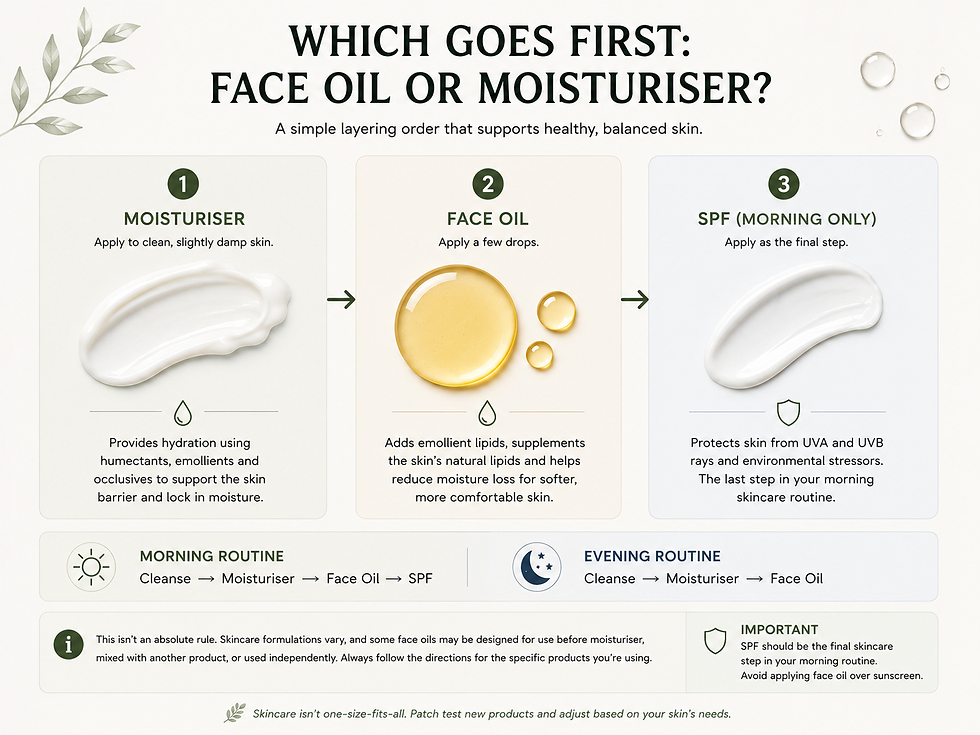
In many skincare routines, a face oil is generally applied after moisturiser.
A conventional moisturiser often contains water alongside humectants, emollients and occlusive ingredients, while a face oil is predominantly lipid-based. Applying the moisturiser first allows it to provide hydration and barrier support before the face oil adds further emollience and lipid support.
A typical morning routine might therefore look like:
Cleanse → Moisturiser → Face Oil → SPF
And at night:
Cleanse → Moisturiser → Face Oil
However, this isn't an absolute rule. Skincare formulations vary considerably, and some face oils may be designed for use before moisturiser, mixed with another product, or used independently. Always follow the directions for the specific products you're using.
The most important rule is that SPF should be the final skincare step in your morning routine, rather than applying a face oil over sunscreen.
Can Face Oil Replace Moisturiser?
Sometimes - but not because an oil is equivalent to a moisturiser.
A face oil can provide emollience and supplement surface lipids, and some oils can reduce water loss to varying degrees. For someone whose skin already maintains hydration effectively, that may provide sufficient comfort.
However, an anhydrous face oil doesn't contain the aqueous phase or conventional water-soluble humectants found in many moisturisers. Someone experiencing dehydration may therefore benefit more from a product designed specifically to support both water retention and barrier function. This distinction is particularly important when deciding whether your skin is dry, dehydrated or both.
Related Guide: Dry Skin vs Dehydrated Skin: What's the Difference?
Which Is Better for Your Skin?
Neither is universally better. Choose based on what your skin actually needs:
If your skin is dehydrated:Prioritise hydration and barrier support. A well-formulated moisturiser will generally be the more logical starting point.
If your skin is dry:Additional emollient lipids from a face oil may improve softness and comfort alongside an appropriate moisturiser.
If your skin is oily:You don't automatically need to avoid either category. Texture, formulation and your individual skin response matter more than the word "oil" on the label.
If your skin feels comfortable with moisturiser alone:There's no biological requirement to add a face oil simply because it's another skincare step.
Formulator's Insight
"From a formulation perspective, asking whether face oil or moisturiser is "better" misses the more important question: what do we want the formulation to achieve?
A conventional moisturiser allows water-soluble humectants and oil-soluble emollients to exist within the same emulsion. A face oil is an anhydrous system whose strengths lie primarily in its lipid composition, emollience and ability to carry oil-soluble ingredients.
That means the two formats don't need to compete. When thoughtfully formulated, they can perform distinct roles within the same skincare routine."
Key Takeaways
Moisturisers and face oils perform different but complementary functions.
Moisturisers typically combine water with humectants, emollients and occlusive ingredients to support hydration and barrier function.
Face oils primarily provide emollience and lipid support, helping soften and smooth the skin.
Some face oils can help reduce moisture loss, but an oil is not automatically equivalent to a moisturiser.
Dehydrated skin will generally benefit from prioritising hydration and barrier support, while dry skin may benefit from additional emollient lipids.
You can use both, but more skincare isn't necessarily better - what matters is what your skin actually needs.
Related Guides

Frequently Asked Questions
Is face oil better than moisturiser?
Neither is inherently better. Moisturisers generally provide broader hydration and barrier support, while face oils primarily provide emollience and lipid support. Which is more appropriate depends on your skin and the individual formulation.
Can I use face oil instead of moisturiser?
You can, but they aren't functionally identical. An oil-only product doesn't provide the aqueous phase or conventional water-soluble humectants found in many moisturisers. If your skin is dehydrated, a moisturiser may therefore be more appropriate.
Should face oil go before or after moisturiser?
Generally, face oil is applied after moisturiser. However, always consider the directions for the particular products you're using because formulations vary.
Can I use face oil every day?
Many face oils are suitable for daily use, but frequency depends on your skin, the formulation and the rest of your routine. Some people may find a few drops sufficient, while others may not need an additional oil at all.
Can oily skin use face oil?
Yes. Having oily skin doesn't automatically mean you must avoid facial oils. However, whether a particular oil or formulation suits oily or acne-prone skin depends on the complete formulation and individual response.
Does face oil hydrate the skin?
It's more accurate to say that face oils primarily soften the skin and support moisture retention rather than directly supplying water. Some oils can reduce water loss, but their effects vary according to their composition.
Scientific References
Lodén, M. (2003). Role of topical emollients and moisturizers in the treatment of dry skin barrier disorders. American Journal of Clinical Dermatology, 4(11), 771–788.
Rawlings, A.V. and Harding, C.R. (2004). Moisturization and skin barrier function. Dermatologic Therapy, 17(Suppl. 1), 43–48.
Proksch, E., Brandner, J.M. and Jensen, J.-M. (2008). The skin: an indispensable barrier. Experimental Dermatology, 17(12), 1063–1072.
Vaughn, A.R., Clark, A.K., Sivamani, R.K. and Shi, V.Y. (2018). Natural oils for skin-barrier repair: ancient compounds now backed by modern science. American Journal of Clinical Dermatology, 19(1), 103–117.


