Does Drinking Water Hydrate Your Skin?
We're often told that drinking more water is the secret to hydrated, glowing skin. It sounds logical: if your skin contains water, surely drinking more of it should make dry or dehydrated skin disappear?
The reality is more nuanced. Water is essential for normal body function, including the skin. But skin hydration isn't determined simply by how much water you drink. The skin's ability to maintain hydration also depends on the structure of the stratum corneum, natural moisturising factors, skin lipids and how effectively the barrier limits excessive water loss.
So, does drinking water hydrate your skin? If you're already adequately hydrated, evidence that simply drinking additional water will dramatically improve skin hydration is limited. Drinking enough fluid remains important for overall health, but topical skincare and barrier function play different roles in maintaining moisture within the outer layers of the skin.
If you're new to how the skin controls moisture, start with our Skin Barrier: The Complete Guide.

How Does Water Reach Your Skin?
The water present in your skin doesn't primarily come from splashing water onto its surface.
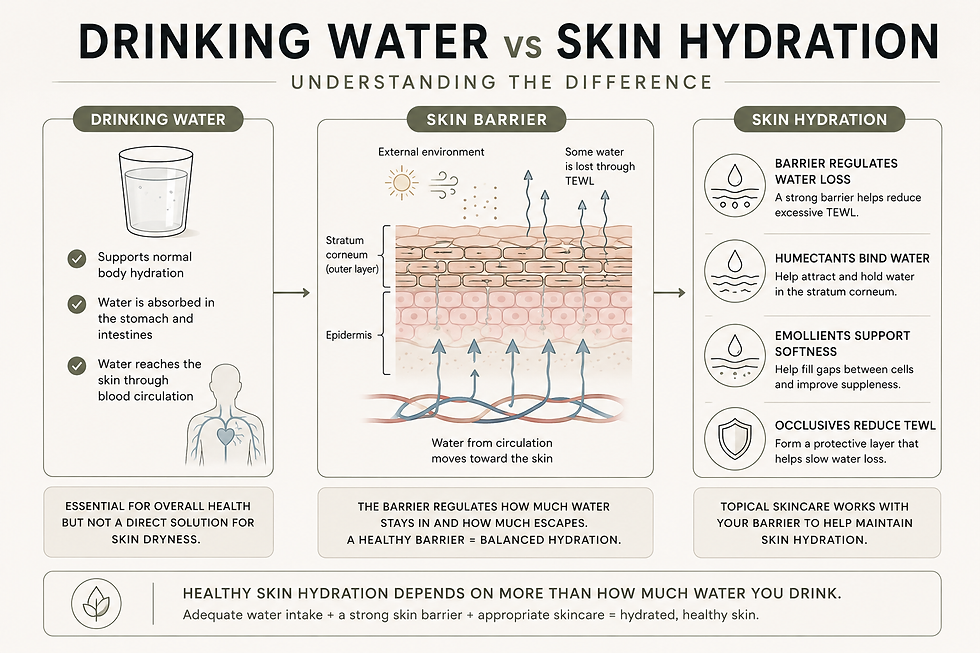
Water reaches the skin through the body's circulation and moves from deeper tissues towards the epidermis. As it moves towards the surface, some is eventually lost to the environment through transepidermal water loss (TEWL). The stratum corneum helps regulate this process.
A healthy barrier doesn't stop water loss completely - nor should it. Instead, its structure helps control how readily water escapes while maintaining an appropriate environment within the outer skin.
Related Guide: What Is Transepidermal Water Loss (TEWL)?
Does Drinking More Water Improve Skin Hydration?
This is where the evidence becomes less definitive.
Some studies have reported improvements in measures of skin hydration after increasing water intake, particularly among people who previously consumed relatively little water.
However, the available research is limited, and there isn't strong evidence that drinking increasingly large quantities of water produces progressively more hydrated skin in otherwise adequately hydrated people.
A 2018 systematic review found that increasing dietary water intake may have a positive effect on skin physiology, particularly in people with lower habitual water consumption, but also concluded that the evidence was weak in both quantity and methodological quality (Akdeniz et al., 2018).
So the scientifically responsible answer is:
Drinking adequate water is important for health, but drinking extra water isn't a substitute for supporting the skin barrier or using appropriate topical skincare.
Hydrated Body vs Hydrated Skin
This distinction is important.
Systemic hydration describes the body's overall fluid balance.
Stratum corneum hydration describes water within the outermost layer of the skin.
They're related - but they're not interchangeable measures.
Someone can drink an appropriate amount of fluid and still experience dry-feeling skin because skin hydration is influenced by factors including barrier function, lipid composition, environmental humidity, cleansing and skincare.
Similarly, drinking another litre of water doesn't directly replace the functions of a moisturiser.
What Actually Helps Keep Skin Hydrated?
Healthy skin hydration depends on both water availability and the skin's ability to retain it.
Maintain Adequate Fluid Intake
Drinking enough fluid is important for normal physiological function. If someone is inadequately hydrated, correcting that matters for overall health.
But once adequate hydration is achieved, simply drinking increasingly large quantities of water shouldn't be viewed as a skincare treatment.
Support the Skin Barrier
The stratum corneum helps regulate how readily water escapes from the skin.
When barrier function is disrupted, transepidermal water loss can increase, which can contribute to dryness, tightness and discomfort.
This is why supporting the barrier can be just as relevant to skin hydration as thinking about water itself.
Use Topical Skincare Appropriately
Different moisturising ingredients perform different functions.
Humectants attract and bind water within the outer layers of the skin.
Emollients improve softness and smoothness.
Occlusive ingredients can help reduce excessive water loss.
A well-designed routine may combine these functions depending on what your skin needs.
Related Guide: Humectants, Emollients & Occlusives Explained
Formulator's Insight
"Hydrated skin isn't simply about putting more water in. It's also about helping the skin hold onto the water that's already there. That's why we look at hydration and barrier function together. Water, humectants, emollients and occlusive ingredients all play different roles—and no single one tells the whole story.Good hydration is about balance, not simply more water."
Key Takeaways
Water is essential for normal body and skin function.
Drinking enough fluid supports normal systemic hydration.
Evidence that drinking additional water significantly improves skin hydration in already adequately hydrated people is limited.
Skin hydration is influenced by the stratum corneum and its ability to regulate water loss.
Dry and dehydrated skin aren't necessarily the same thing.
Topical moisturising ingredients work differently from drinking water.
Drinking more water isn't a substitute for appropriate skincare when the issue is dryness or impaired barrier function.
Continue Reading

Frequently Asked Questions
Does drinking water hydrate your skin?
Adequate fluid intake supports normal body hydration, including the skin. However, evidence that drinking additional water substantially improves skin hydration in people who are already adequately hydrated is limited.
Will drinking more water fix dry skin?
Not necessarily. Dry skin can involve reduced lipids and altered barrier function, so drinking more water doesn't directly replace what the skin may be lacking.
How much water should I drink for better skin?
There isn't a scientifically established amount of additional water that everyone should drink specifically to improve their skin.
Fluid requirements vary between individuals and circumstances, so I'd avoid giving a skincare-specific litres-per-day target here.
Can you be dehydrated even if you drink plenty of water?
When we're talking about dehydrated skin, the term is often used in skincare to describe insufficient water in the outer skin layers. That's different from clinical dehydration of the body.
Skin can therefore feel tight or dehydrated even when overall fluid intake is adequate.
Is moisturiser more important than drinking water for skin hydration?
They perform different functions and shouldn't really be treated as alternatives. Adequate fluid intake supports normal physiology, while topical moisturisers act at the skin surface to support hydration, emollience and/or moisture retention.
Scientific References
Akdeniz, M., Tomova-Simitchieva, T., Dobos, G., Blume-Peytavi, U. and Kottner, J. (2018). Does dietary fluid intake affect skin hydration in healthy humans? A systematic literature review. Skin Research and Technology, 24(3), 459–465.
Rawlings, A.V. and Harding, C.R. (2004). Moisturization and skin barrier function. Dermatologic Therapy, 17(Suppl. 1), 43–48.
Verdier-Sévrain, S. and Bonté, F. (2007). Skin hydration: a review on its molecular mechanisms. Journal of Cosmetic Dermatology, 6(2), 75–82.
Proksch, E., Brandner, J.M. and Jensen, J.-M. (2008). The skin: an indispensable barrier. Experimental Dermatology, 17(12), 1063–1072.